
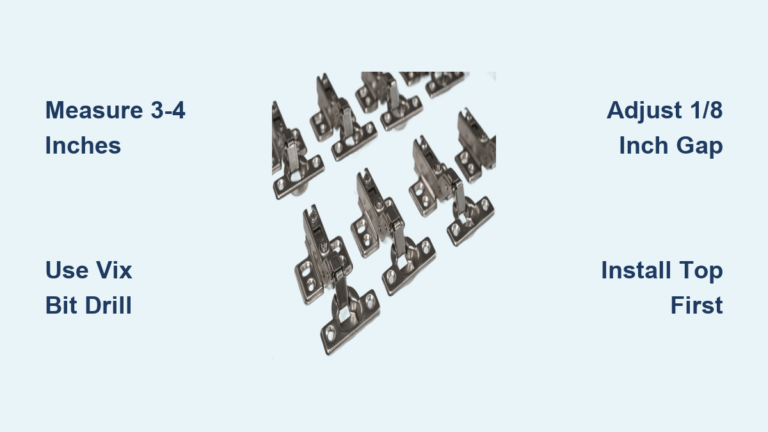
That moment when your kitchen cupboard door hangs crooked or won’t close properly is incredibly frustrating. Whether you’re replacing worn-out hardware or installing new cabinets, knowing how to install kitchen cupboard hinges correctly can transform your kitchen’s functionality and appearance. This comprehensive guide provides the exact steps professional cabinet installers use to achieve perfectly aligned doors with smooth operation. You’ll learn precise measurement techniques, proper hinge positioning for rabbeted doors, and professional adjustment methods that ensure consistent 1/8″ gaps around every door. By the end of this guide, you’ll have the confidence to tackle this project and achieve results that look like they were done by a cabinet specialist.
Essential Tools for Perfect Kitchen Hinge Installation
Before you touch a single screw, having the right tools makes all the difference between a professional finish and a frustrating experience. The Vix bit or self-centering drill bit is non-negotiable for accurate pilot holes—this specialized tool automatically centers your drill bit in the hinge cup, eliminating guesswork. Pair it with a #2 Phillips or square drive screwdriver bit that matches your hinge screws to prevent cam-out and stripped heads. A 4-foot level is crucial for checking door alignment across multiple cabinets, while a 6-in-1 combination square ensures your hinge positions stay perfectly vertical.
Don’t skip the humble 1/8″ shims—they’re your secret weapon for consistent door height. Plastic or wood shims create that perfect gap beneath doors during installation that translates to uniform 1/8″ clearance around all edges. Torx drivers (T15-T30) are increasingly common for modern hinges, so verify which size your hardware requires before starting. Finally, a marking gauge or simple cardboard hinge template saves hours when installing multiple doors, guaranteeing identical hinge placement across your entire kitchen.
Measuring Hinge Placement on 26.5″ Cabinet Doors
Why 3-4 Inches from Top and Bottom Creates Perfect Alignment
For standard 26.5″ kitchen cupboard doors, measuring 3-4 inches from the top and bottom edges creates optimal weight distribution and prevents sagging. This placement works because it positions hinges where the door experiences the least stress during opening and closing. Measure from the outside corner of the door—not from the rabbet edge—to ensure consistency across all cabinets. On rabbeted doors requiring 3/8″ backset hinges, this measurement reference point is critical for proper alignment with the cabinet face frame.
When marking your hinge positions, use a combination square to draw perfectly vertical lines on the door edge. This prevents the common mistake of drilling at a slight angle, which causes doors to bind or close improperly. For an 8-cabinet project, mark all doors simultaneously to maintain uniformity—this saves time and ensures visual consistency throughout your kitchen.
How to Determine Exact Door Height with Precision Marks
The key to professional-looking cabinet doors is consistent vertical alignment. Start by inserting the door into the cabinet opening and placing a 1/8″ shim beneath it. Carefully push the hinge side against the cabinet frame while positioning the door at its highest possible point, then make a pencil mark at the top. Next, lower the door to its lowest possible position and make a second mark. The distance between these marks will typically be 1/4″ or less.
Find the center point between these two marks—that’s your ideal door height. This technique accounts for minor variations in cabinet construction and ensures your doors will have that perfect 1/8″ clearance around all edges. For multiple cabinets, work sequentially from one end to the other, checking alignment between adjacent doors as you go.
Removing Old Hinges and Preparing Your Cabinet Surfaces
Filling Existing Screw Holes for a Professional Finish
When replacing old hinges, thoroughly remove all previous hardware before starting. Existing screw holes often need filling to provide solid wood for new screws. For best results, cut hardwood dowels slightly longer than the screw depth, apply wood glue, and tap them into the holes. Once dry, trim flush with the surface using a sharp chisel. Fill any remaining imperfections with quality wood filler and sand smooth.
This preparation step is non-negotiable for durable installations—screws into filled holes hold 300% better than those placed in stripped-out previous locations. For rabbeted doors requiring 3/8″ backset hinges, take extra care to ensure the hinge mounting surface is perfectly flat. Any unevenness here will translate directly to poor door alignment.
Drilling Perfect Pilot Holes with a Vix Bit for Cupboard Hinges

Why Self-Centering Drill Bits Prevent Common Installation Mistakes
Drilling accurate pilot holes separates DIYers from professionals. The Vix bit’s self-centering feature automatically positions your drill bit precisely in the hinge cup, eliminating the most common alignment error. For standard #8 x 1-1/4″ screws used with 3/4″ cabinet material, use a 7/64″ or 1/8″ drill bit and drill to a depth of about 1/4″—approximately two-thirds the screw length.
To prevent over-drilling, wrap painter’s tape around your drill bit at the proper depth or use a drill with a depth stop. This precision ensures screws bite firmly into solid wood without stripping out or protruding through the other side. When working with concealed cup hinges requiring 35mm holes, use a specialized boring jig to create perfectly sized and positioned cup holes—this is essential for proper hinge function.
Installing Hinges on Rabbeted Doors with 3/8″ Backset Requirements

Positioning Shims for Consistent 1/8″ Door Clearance
Rabbeted doors with 3/8″ backset hinges require special attention to achieve that professional reveal. Place your door in the cabinet opening resting on a 1/8″ shim to establish consistent bottom clearance. Hold the hinge side firmly against the cabinet frame while temporarily installing just one screw in the top hinge—this allows you to check alignment before committing to full installation.
For these specific doors, measure from the outside corner when marking hinge positions, not from the rabbet edge. This ensures the hinge sits correctly within the rabbet cutout. When positioning the hinge plate, verify it sits flush with the door edge—any protrusion here will prevent proper door closure. Partial-wrap hinges are typically best for this application, providing sufficient support while maintaining a clean aesthetic.
Adjusting Concealed Cup Hinges for Perfect Door Alignment
Fixing Uneven Gaps Between Cabinet Doors in 3 Simple Steps
Most modern concealed hinges feature four adjustment points that let you fine-tune door position after installation. Start with vertical adjustment using the screw at the base of the hinge plate—turn clockwise to raise the door, counterclockwise to lower it. Next, adjust side-to-side position with the screw on the frame mount, moving the door left or right as needed.
For the critical in/out adjustment that controls the gap between door and frame, use the screw on the arm connecting the door and base plate. Aim for a consistent 3mm (1/8″) gap around the entire door. Finally, if your hinges have soft-close functionality, adjust tension in ¼ turn increments until doors close smoothly without slamming. These micro-adjustments transform a “close enough” installation into a professional-looking job.
Troubleshooting Common Hinge Installation Problems

Why Your Kitchen Cupboard Door Won’t Close Properly (and How to Fix It)
Sticking doors are the most frequent issue after hinge installation. If your door rubs against the cabinet frame, the solution usually lies in the hinge depth setting. Loosen the mounting screws slightly, then use the in/out adjustment screw to move the entire door away from the frame by about 1/16″ increments until clearance is achieved.
For doors that won’t stay partially open, check your hinge tension adjustment—many concealed hinges have a small screw near the hinge cup that controls this feature. If doors sag over time, it typically indicates insufficient screw grip; remove the hinge, fill the holes with hardwood dowels, and reinstall with fresh screws. Uneven gaps between double doors often require adjusting just one hinge to create perfect symmetry at the meeting point.
Professional Techniques for Installing Multiple Cabinet Doors
Creating a Cardboard Template for Consistent Hinge Placement
When installing hinges on multiple cabinets, consistency is everything. Create a simple cardboard template by tracing one properly positioned hinge onto sturdy cardboard, then cutting out the shape. This template ensures identical hinge placement across all doors, eliminating the “why does this door look different?” problem.
For perfect alignment across an entire cabinet run, install doors sequentially from one end to the other, checking reveal consistency with playing cards (each card is approximately 0.010″ thick). Professional installers often use a single reference point—like the highest cabinet—and work down from there, making minor adjustments as needed. Always install top hinges first, then bottom hinges, and never fully tighten all screws until you’ve verified perfect alignment.
Final Quality Check: Ensuring Smooth Operation of All Cabinet Doors
Before calling your project complete, conduct a thorough quality check. Open and close each door multiple times, verifying smooth operation without binding or sticking. Check alignment in both open and closed positions—doors should sit perfectly flush when closed and remain stable at any open angle.
Use a 4-foot level to verify vertical alignment across multiple doors, and check for consistent 1/8″ gaps around all edges. For soft-close hinges, test the closing mechanism to ensure doors shut gently without slamming. Finally, tighten all screws to proper torque—overtightening can strip holes, while undertightening leads to premature sagging. With these final checks complete, you’ll enjoy cabinet doors that function perfectly and look professionally installed for years to come.


