Your kids staring at their shoes after 10 minutes on the trail? That’s the universal signal that your family hike is about to become a battle of wills. But what if you could transform those whines into wonder with proven hiking activities for kids that turn every step into discovery? Forget forcing children to march in silence—the secret lies in turning nature into their personal playground. This guide delivers 12 actionable games and challenges tested by thousands of families, designed to ignite curiosity from toddlers to tweens while building lifelong connections to the outdoors. You’ll discover how to spot animal clues like a wildlife detective, create miniature worlds from sticks and stones, and turn mundane trails into treasure hunts—all without expensive gear or complicated prep.
Trail Scavenger Hunt Hacks That Actually Work
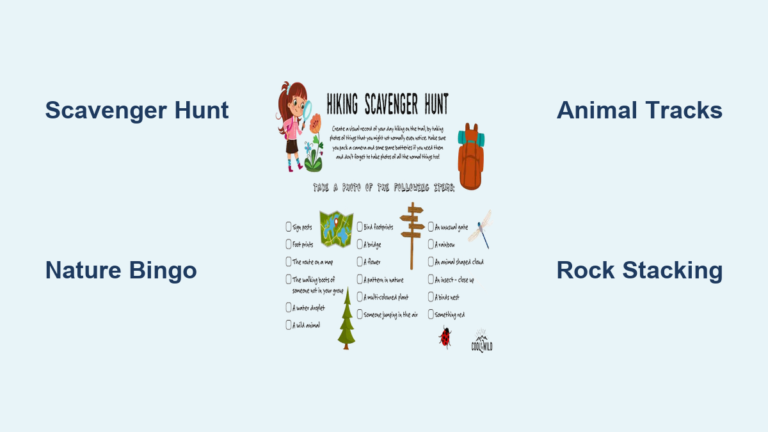
Ditch the boring “find a pinecone” lists that kids ignore after five minutes. Transform your hike into a mission with sensory-based scavenger hunts that engage multiple senses simultaneously. For preschoolers, use picture cards showing textures: a fuzzy moss patch, a smooth river stone, or a crunchy leaf. For school-aged kids, challenge them to find “something that smells like rain,” “a leaf shaped like a heart,” or “a sound that makes you smile.” The key is specificity—instead of “find animal tracks,” have them locate “three different paw prints near the muddy stream.” Always carry a small bag for non-living treasures (never disturb plants or wildlife), and set a time limit of 15-20 minutes to maintain urgency. Pro tip: If kids struggle, become the “hint whisperer” by dropping subtle clues like “I just saw something shiny near the big oak’s roots.”
Nature Bingo: Zero-Prep Trail Magic
Skip complicated setups with this instant engagement tool. Sketch nine quick squares on paper before your hike: a feather, red berry, spiderweb, squirrel, cloud shaped like an animal, mushroom, bird song, smooth rock, and something yellow. For non-readers, use simple drawings. Hand each child a pencil and challenge them to mark squares as they spot items. The real genius? It forces slow observation—you’ll hear “Mom! Look at this tiny mushroom!” instead of “Are we there yet?” If your trail lacks certain items, swap in local specifics: “bear claw marks” in national parks or “sea glass” on coastal hikes. Win instantly by offering a “trail mix trophy” (a small bag of their favorite snack) for the first completed card.
Wilderness Detective Missions That Teach Real Skills

Stop telling kids “don’t touch anything” and turn them into active investigators. At the trailhead, hand them a magnifying glass (packed in your essentials bag) and declare: “Today we’re tracking the Forest Phantom.” This reframes ordinary hikes into forensic adventures where every snapped twig becomes evidence.
Crack the Case of Animal Tracks
Kneel beside muddy patches and ask: “Was this visitor big or small? How many toes did they have? Where were they hurrying to?” Compare prints to your palm—deer tracks fit inside your hand, while raccoon prints resemble tiny human hands. For safety, teach the “look but don’t touch” rule for scat (animal droppings), noting how rabbit pellets look like chocolate chips while deer droppings resemble rice. If kids get discouraged, create “clue stations” beforehand by pressing toy animal feet into soft soil near the trail. The payoff? When they spot real evidence later, their confidence soars.
Find Hidden Animal Apartments
Shift focus upward with “treetop treasure hunting.” Challenge kids to spot three types of wildlife homes: squirrel dreys (leafy nests high in branches), woodpecker holes, and ant colonies under logs. Use a countdown (“You have 2 minutes to find the coziest bug hotel!”) to maintain momentum. For shy children, start with obvious signs like chewed acorns or stripped bark before hunting subtle clues. This builds habitat awareness without disturbing creatures—remember, we observe homes but never peek inside nests.
Nature’s Art Studio: Creative Pit Stop Solutions

When little legs scream for rest, skip the boring snack break with quick-build projects using only trail-found materials. These activities recharge energy while developing fine motor skills—critical for kids who fidget on long hikes.
Build a Mini-Dinosaur Habitat
Challenge: “Construct a home that could shelter a T-Rex the size of your thumb.” Gather materials in under 5 minutes: flat stones for foundations, twigs for walls, broad leaves for roofs. The magic happens when you add constraints: “Your habitat must have a water source (a dewdrop counts!)” or “Make it invisible to eagle eyes.” This transforms passive rest stops into engineering challenges where balancing a pebble roof teaches physics better than any textbook. Always disassemble creations before leaving to leave no trace.
Rock Stacking Physics Challenge
Find a durable spot away from trails (like a gravel riverbank) and issue the “30-Second Tower Challenge.” Start with a palm-sized base stone, then stack progressively smaller rocks. The twist? Time each attempt while discussing why certain shapes balance better. When towers inevitably collapse (as they will!), celebrate “epic fails” with high-fives—this normalizes mistakes while teaching center of gravity concepts. For group hikes, make it cooperative: “Can our team build a tower taller than your boot?”
Trail Games That Prevent “Are We There Yet?” Meltdowns
Keep momentum going during long stretches with movement-based games requiring zero equipment. These combat fatigue by burning excess energy while training observation skills.
I Spy: Nature Edition with a Twist
Elevate the classic with sensory clues: “I spy something that feels like velvet” (moss) or “something that sings when the wind blows” (dry reeds). For advanced players, add time pressure: “You have until we reach that bend to guess!” If kids stall, become the “clue generator” by whispering hints: “It’s clinging to the tree we just passed.” This version works wonders on monotonous trail sections where regular I Spy grows stale.
Human Camera: The Quiet Focus Game
Perfect for calming hyperactive energy during rest stops. Pair up: the “photographer” guides the blindfolded “camera” (using gentle shoulder taps) to a fascinating micro-scene—a dewdrop on a spiderweb, intricate bark patterns, or overlapping leaves. The “camera” opens eyes for exactly 5 seconds to “capture the image,” then describes every detail. Rotate roles so each child experiences both leadership and focused observation. This builds patience while revealing nature’s hidden details most adults miss.
Adventure Challenges for Young Trailblazers

Turn the entire hike into an achievable quest with these destination-focused missions. They provide psychological milestones that make distances feel conquerable.
The Magical Map Navigation Challenge
Before hiking, sketch a child-friendly map highlighting 3-4 landmarks: “Giant Rock Bridge,” “Twisty Pine Tree,” and “Sparkly Creek Crossing.” Give your child the map plus a compass (or just verbal directions like “next we turn left at the waterfall sound”). At each checkpoint, let them cross off locations with a triumphant “X.” The payoff? A hidden “treasure” at the end—your secret snack stash or a special nature item you stashed beforehand. This builds navigation confidence while making kids feel like true explorers.
One-Square-Meter Expedition
When energy wanes, declare a “micro-hike” by laying down an imaginary hula-hoop boundary. Equip kids with magnifying glasses and challenge them to catalog everything inside: “Find five different insects,” “count moss varieties,” or “spot evidence of animal visitors.” The revelation? How much life exists in a tiny patch they’d normally stomp through. Set a 7-minute timer for urgency, then compare discoveries. This resets attention spans while teaching ecosystem awareness.
Proven Strategies for Engaging Kids on Every Hike
Your success hinges on three non-negotiables: flexibility, celebration, and curiosity modeling. Always pack the “Pro-Tip Pack”—a small bag with a magnifying glass, crayons, and a waterproof notepad for rubbings. But the real game-changer? Letting kids lead 20% of the hike. When they choose the path or stop for “just one more bug,” ownership skyrockets. Celebrate micro-wins wildly: “You spotted that camouflaged caterpillar like a pro!” Most crucially, voice your own wonder aloud—”Wow, how did that leaf get shaped like a star?”—because kids mirror adult enthusiasm.
Never force completion of activities; swap games when interest fades. If scavenger hunts flop, pivot to “sound mapping” where kids sit silently for 3 minutes noting directional sounds on paper. Remember, the goal isn’t summiting peaks—it’s planting seeds of wonder. End hikes by asking: “What’s one magic thing you’ll remember?” Their answers will guide your next adventure.
Final Takeaway: The most successful hiking activities for kids feel like play, not education. By turning trails into treasure maps and forests into detective labs, you transform resistance into revelation. Start small with just one scavenger hunt or rock stack this weekend—when kids return home buzzing about “the dinosaur house we built,” you’ll know you’ve unlocked the secret: nature isn’t just a place to visit, it’s their birthright playground. Pack curiosity, leave expectations behind, and let the next adventure begin at your doorstep.