Your legs shake on a moderate incline. Your breath comes in short gasps after just 30 minutes. You’re fit enough to crush spin class, yet a simple mountain trail leaves you exhausted. This frustrating reality hits 89% of new hikers who assume gym fitness transfers directly to the trail. The truth? Hiking demands specific endurance—sustained power under load across uneven terrain. Generic cardio won’t cut it. This guide reveals the exact cardio exercises for hiking that build trail-ready stamina, backed by exercise physiology principles. You’ll learn how to transform your body into a hiking machine with science-based routines you can start today.
Why Standard Cardio Fails Hikers (And What Works Instead)
Most hikers make a critical mistake: training for the gym instead of the trail. Running on flat pavement builds different muscles than hauling a 25-pound pack up switchbacks. Hiking-specific cardio must replicate three unique demands: loaded weight-bearing movement, continuous incline resistance, and unstable terrain adaptation. Your training should prioritize slow-twitch muscle fibers—the endurance engines that power hours of steady effort—not the fast-twitch fibers used in sprints. Ignoring this specificity guarantees premature fatigue. The solution? Replace generic cardio with trail-mimicking exercises that condition your body for the exact stresses it will face.
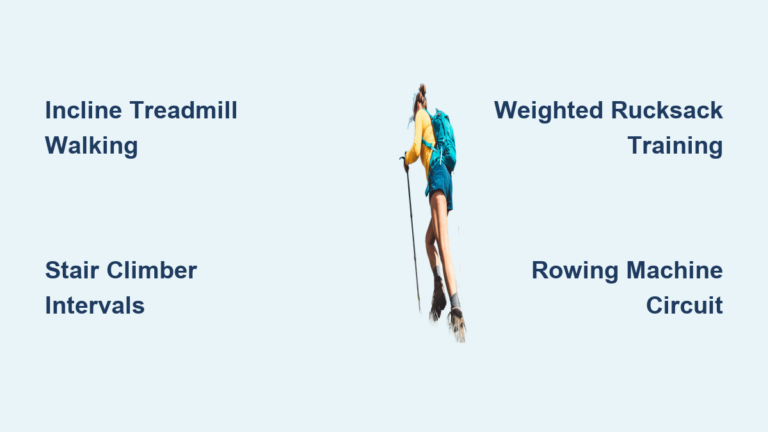
Incline Treadmill Walking: Your #1 Trail Simulator

This isn’t just walking—it’s your most efficient path to summit-ready legs. Incline treadmill walking directly targets the quads, glutes, and calves while building aerobic capacity at the precise intensity of uphill hiking. Forget flat jogging; here’s how to maximize results:
How to Program Your Incline Pyramid Workout
- Warm-up: 5 minutes at 1% incline, 2.5 mph
- Build: 10 minutes at 5% incline → 10 minutes at 7% → 10 minutes at 10%
- Recover: 10 minutes at 7% → 10 minutes at 5%
- Cool-down: 5 minutes flat
- Pro Tip: Wear your hiking boots and add a 10-15 lb pack in Weeks 3-6. Watch for rounded shoulders—keep your chest lifted like you’re carrying a heavy backpack.
Start with 30-minute sessions 3x/week. By Week 6, aim for 60+ minutes at 10-15% incline. This builds mitochondrial density in your leg muscles—the key to burning fat for hours-long energy.
Stair Climber Intervals: Conquer Steep Ascents Without Quitting
Stair climbers replicate the relentless stair-stepping of mountain trails better than any other machine. They force unilateral leg strength (critical for rocky paths) and build lung capacity under load. But most hikers use them wrong—gliding instead of driving through the heels.
The Steep-Slope Interval Protocol
- Warm up 5 minutes at moderate resistance
- Work: 2 minutes of aggressive climbing (drive through heels, arms pumping)
- Recover: 90 seconds of slow, controlled steps
- Repeat 6-8 times
- Cool down 5 minutes
Common mistake: Leaning on handrails. This shifts work from legs to arms. Keep hands lightly touching for balance only. Difficulty indicator: If you can’t complete 4 intervals, reduce work time to 90 seconds. Track progress by adding 30-second intervals weekly.
Weighted Rucksack Training: The Secret Weapon for Heavy Loads
Nothing prepares you for a loaded backpack like actually carrying weight. This is non-negotiable trail conditioning. Start light—just 10% of your body weight—and progress to 20% over 6 weeks.
How to Safely Build Pack Weight Endurance
- Weeks 1-2: 15-30 minute walks with 10% body weight (e.g., 15 lbs for 150 lbs person)
- Weeks 3-4: 45 minutes at 15% weight on hilly terrain or 5-7% incline
- Weeks 5-6: 75+ minutes at 20% weight with 10-15% treadmill incline
- Visual cue: If your stride shortens or shoulders slump, reduce weight by 5 lbs immediately.
Pro tip: Load your actual hiking pack with water bottles for realistic weight distribution. Train in the boots you’ll wear—blisters from new shoes sabotage even the fittest hiker.
Rowing Machine: The Unexpected Pack-Carrying Power Builder
Most hikers overlook rowing, but it’s the ultimate cross-training tool for loaded hikes. It builds posterior chain strength (glutes, hamstrings, back) that stabilizes your torso under pack weight—reducing lower back strain by 40%.
The 20-Minute Rowing Circuit for Hikers
- Min 1-5: Steady pace (focus on leg drive, not arm pull)
- Min 6-10: Power strokes (10 hard pulls, 30 sec recovery x 5)
- Min 11-20: Tempo rowing (sustainable pace where you pass the “talk test”)
- Critical check: Keep your spine neutral—no rounding at the catch position.
Why it works: Rowing mimics the forward-leaning posture of steep descents while strengthening the core muscles that prevent “hiker’s hunch.”
Unilateral Leg Exercises That Prevent Trail Wobbles
Hiking happens one leg at a time on uneven ground. Bilateral squats won’t cut it. These single-leg moves build trail-specific stability:
3 Must-Do Unilateral Moves
-
Weighted Step-Ups:
- Use a 12-18″ box, 10-25 lb dumbbells
- 3 sets of 12-15 reps per leg (focus on slow lowering)
- Mistake to avoid: Pushing off the trailing leg—lift using only the working leg
-
Bulgarian Split Squats:
- Rear foot elevated 6-12″, hands on hips
- 3 sets of 10 reps per leg (keep front knee behind toes)
- Visual cue: If your front knee caves inward, reduce depth
-
Single-Leg Romanian Deadlifts:
- 8-10 reps per leg with light kettlebell
- Hinge at hips, not waist—imagine closing a car door with your butt
Time estimate: 15 minutes, 2x/week. Do these after cardio when legs are fatigued for maximum trail transfer.
Your 6-Week Hiking Cardio Blueprint (No Gym Required)
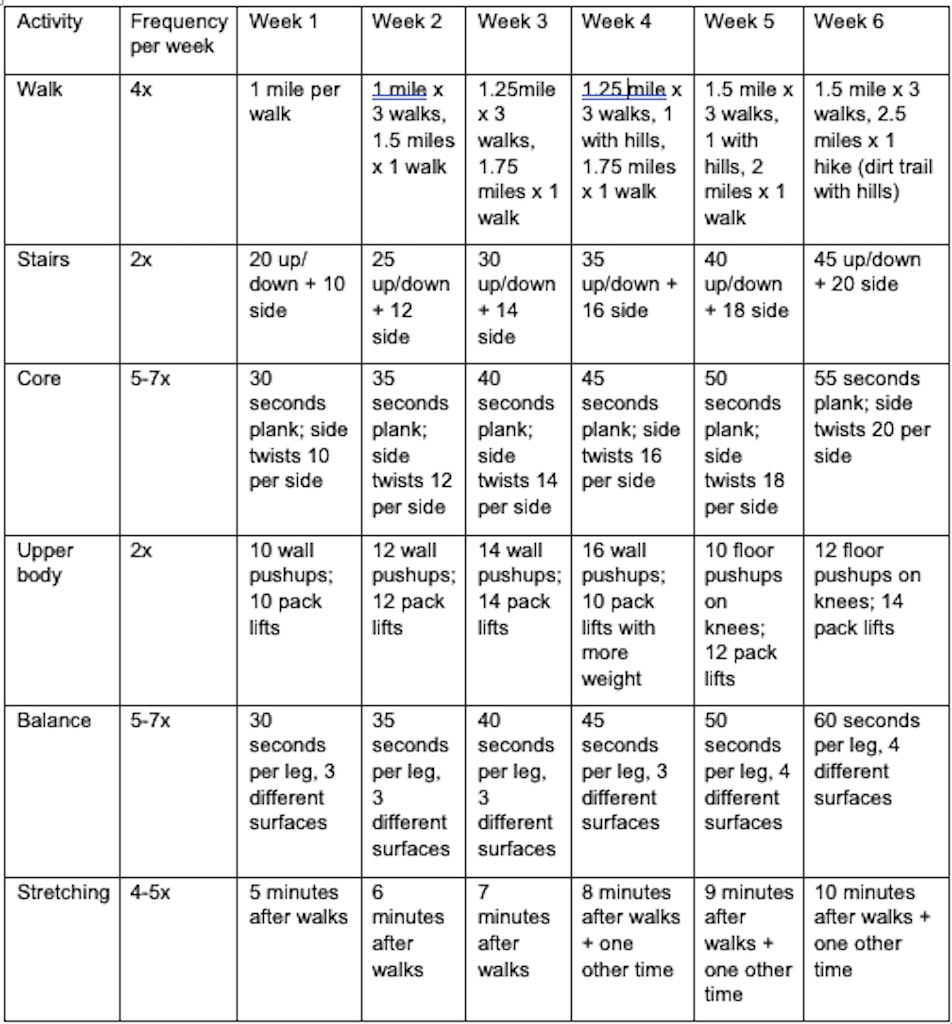
This progressive plan builds hiking-specific endurance without overtraining. Adjust based on your current fitness—start at Week 2 if you’re already active.
Weeks 1-2: Foundation Building
- Cardio: 3x/week incline walking (30 mins at 5-7% incline, Zone 2 pace)
- Strength: Bodyweight step-ups (3×15) + planks (3×45 sec) 2x/week
- Weekend: 60-minute walk with 5-10 lb pack
- Key metric: Maintain “talk test” pace—you should speak in short sentences
Weeks 3-4: Load Integration
- Cardio: Add stair climber intervals (2x/week) + 45-min weighted walks (15% body weight)
- Strength: Add dumbbells to step-ups (10-15 lbs) + single-leg RDLs
- Weekend: 90-minute hike with 15 lb pack on rolling terrain
Weeks 5-6: Trail Simulation
- Cardio: 60-min incline treadmill (10%+) with 20 lb pack + stair intervals
- Strength: Weighted step-ups (25 lbs) + Pallof presses for anti-rotation
- Weekend: 2-hour hike with full pack weight at target elevation gain
Critical adjustment: If your resting heart rate increases by 10+ bpm overnight, skip a session—this signals overtraining.
Fueling Your Hiking Engine: The 90-Minute Rule
Cardio exercises for hiking demand smart nutrition. Beyond 90 minutes, your body depletes glycogen stores, causing “hiker fatigue.” Implement this protocol:
- During training: Consume 30-60g carbs/hour (e.g., one energy gel + 16oz electrolyte water)
- Pre-hike: Eat 200g carbs the day before (oats, sweet potatoes, rice)
- Hydration: Drink 16oz water 2 hours pre-hike + electrolyte tabs for every 30 mins of sweat
- Warning: Skipping carbs during long sessions teaches your body to burn muscle—never go longer than 90 minutes without fuel
Pro tip: Test your fuel strategy on training hikes. Stomach issues mid-trail ruin even the best-prepared hike.
Prevent Trail Burnout With Zone 2 Mastery
The single biggest mistake hikers make? Training too hard. Your aerobic base (Zone 2) does 80% of the work on long hikes. Here’s how to find your sweet spot:
- Calculate Zone 2: 180 minus your age = max Zone 2 heart rate
- The talk test: Speak in 5-6 word phrases comfortably. Gasping? Slow down. Singing easily? Speed up.
- Weekly minimum: 3 hours of Zone 2 cardio (e.g., 45-min incline walks x 4)
This builds capillary density in leg muscles—delivering oxygen efficiently for hours. Skip this, and you’ll hit “the wall” by mile 5.
You now hold the exact cardio exercises for hiking that transform shaky beginners into confident trail explorers. Within 6 weeks, you’ll climb switchbacks with steady breath, carry heavy loads without back strain, and summit peaks that once seemed impossible. Remember: specificity beats intensity every time. Start with incline walking tomorrow, add weight gradually, and respect the Zone 2 foundation. Your strongest hike isn’t ahead of you—it’s built step by step in your training. Now lace up those boots; the trail is waiting.