
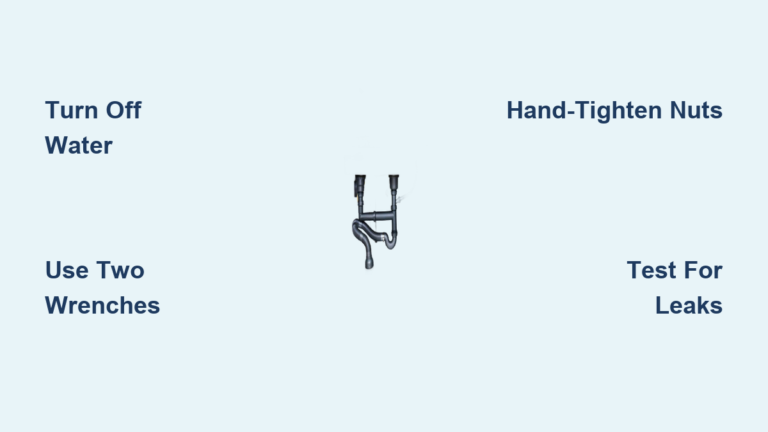
That puddle under your sink isn’t going to vanish on its own. When your kitchen pipes start leaking, corrosion sets in, or drainage slows to a crawl, replacing the P-trap and supply lines becomes urgent. Ignoring these issues risks water damage to cabinets, flooring, and even structural elements. The good news? You can fix most common kitchen pipe failures yourself in under two hours with basic tools. This guide cuts through the confusion to show you exactly how to replace kitchen pipes safely—avoiding costly mistakes like cracked fittings, persistent leaks, and accidental floods. You’ll learn precise techniques for disconnecting stubborn connections, making leak-proof metal-to-plastic transitions, and testing your work like a professional plumber.
Turning Off Water and Preparing for Pipe Replacement
Never skip this critical step—90% of DIY plumbing disasters start with forgotten water shutoffs. Locate your home’s main water valve (usually in the basement, crawlspace, or near the water meter) and turn it clockwise until fully closed. Now open both hot and cold kitchen faucets to drain residual water and relieve pressure in the lines. Keep them open until water stops flowing. While water drains, gather these essentials: two adjustable wrenches (8-10 inch size works best), channel-lock pliers, bucket, microfiber towels, pipe thread tape, and a new P-trap kit sized for kitchen sinks (1¼-inch standard). Place the bucket directly under the P-trap’s lowest point—this U-shaped pipe always holds standing water that will spill when disconnected. Pro Tip: Line the bucket with a towel to muffle splashes and prevent murky water from sloshing out.
Why You Must Use Two Wrenches for Every Connection
Forcing slip nuts with a single wrench twists pipes and cracks joints. Always grip the stationary side of the connection with one wrench while loosening the nut with the other. This prevents stress on the wall drain pipe and sink tailpiece. If connections resist turning, apply penetrating oil to threads and wait 5 minutes—but never hammer plastic fittings. For corroded metal nuts, carefully heat the joint with a hairdryer for 30 seconds to expand the metal before attempting to loosen.
Removing Old Drain Pipes Without Damaging Connections

Disconnecting a Stubborn P-Trap Safely
Position your bucket under the P-trap’s curved section. Identify the slip nuts: larger nuts connect to the wall drain pipe and sink tailpiece, smaller nuts join the P-trap arms. Grip the P-trap arm firmly with one wrench while turning the slip nut counterclockwise with the second wrench. Stop immediately if you feel plastic cracking—this means you’re applying sideways force. For frozen connections, tap the nut’s edge gently with a hammer to break corrosion bonds. Once loose, unscrew by hand and lower the P-trap into the bucket. Dump standing water away from your work area before proceeding.
Handling Metal-to-Plastic Drain Pipe Transitions
If your wall pipe is galvanized steel (dull gray, threaded) connecting to plastic pipes, expect complications. Unscrew the plastic trap adapter from the metal pipe—never cut metal threads directly into plastic fittings. Inspect the metal pipe end for sharp burrs that could slice new plastic washers. Use emery cloth to smooth rough edges if needed. Note the pipe diameter: most kitchen wall drains are 1½-inch while P-traps are 1¼-inch. You’ll need a reducing washer (1¼” x 1½”) to bridge this gap—keep this critical adapter in your kit.
Installing Leak-Proof Drain Pipes in 4 Critical Steps
Choosing Correct Pipe Adapters for Your Setup
Mismatched pipe sizes cause 70% of post-replacement leaks. Verify your wall pipe diameter with a tape measure before buying parts. For 1½-inch metal wall pipes connecting to 1¼-inch plastic P-traps:
– Use a 1½-inch slip-joint nut with reducing washer (flat rubber ring with stepped hole)
– Never force a 1¼-inch trap arm directly onto 1½-inch pipe
– For severely corroded metal pipes, install a Fernco shielded coupling instead of threaded adapters
Assemble dry-fit components first without tightening. The P-trap must hang freely without straining toward connections—if pipes don’t align naturally, you need extension tubes, not force.
Hand-Tightening Technique That Prevents Cracks
Slip nuts require finesse, not brute strength. Slide the rubber washer onto the pipe first with the beveled edge facing the nut. Hand-tighten until resistance increases, then give exactly ¼ turn with wrenches. Over-tightening by just ½ turn cracks plastic 9 times out of 10. Test alignment: the P-trap should pivot freely when gently nudged. If connections feel rigid, disassemble and add a 2-inch extension tube to relieve stress.
Replacing Water Supply Lines Without Springing Leaks

Installing Braided Stainless Steel Supply Lines Correctly
This single mistake causes most under-sink floods: skipping the pipe thread tape. Wrap cold water supply threads with white Teflon tape (1.5 layers clockwise). For hot water lines, use pink tape rated for higher temperatures. Screw the supply line hand-tight onto the shutoff valve—never reuse old rubber washers as they harden and crack. Hold the valve body steady with one wrench while tightening the supply line nut ¼ turn past hand-tight. Repeat for faucet connections, ensuring hot (red) and cold (blue) lines match faucet markings.
Why Flexible Drain Pipes Cause Clogs (and What to Use Instead)
Never install accordion-style corrugated drain pipes as permanent fixtures. Their ridges catch food scraps and grease, creating clogs within weeks. They also violate plumbing codes in most municipalities. Instead:
– Use rigid PVC pipes for 90% of the run
– Add only a 2-inch flexible section if absolutely needed for alignment
– Always maintain ¼-inch downward slope per foot toward the wall drain
Testing Your Work Like a Professional Plumber
The 5-Minute Leak Detection Method
Turn main water supply on slowly—rushing water pressure blows loose connections. Open shutoff valves under sink, then run cold water at faucet for 60 seconds. With a dry paper towel, wipe every connection starting from shutoff valves down to P-trap. Check for:
– Immediate drips: Overtightened or cracked joint (disassemble and replace washer)
– Slow seepage: Under-tightened slip nut (give ⅛ turn with wrench)
– Foggy moisture: Condensation (not a leak—insulate pipe instead)
Critical Test: Fill sink basin completely, then pull the stopper. Water must drain within 30 seconds. Slow drainage means improper pipe slope or clog further down the line.
When to Stop DIY and Call a Professional Plumber
Immediately shut off water and call a pro if you encounter:
– Rust-colored water after turning supply back on (indicates corroded main pipes)
– Cracks in wall drain pipes extending into cabinetry
– Leaks persisting after two re-tightening attempts
– Sewer gas odor (sign of P-trap installation error)
For standard P-trap and supply line replacements, you’ve now mastered a skill saving $150+ per service call. But know your limits—pipes hidden inside walls or slab foundations require professional camera inspection and pipe bursting tools.
Final Leak-Proof Checklist Before Closing Cabinet
✅ All slip nuts tightened to ¼-turn past hand-tight (no more)
✅ P-trap slopes downward toward wall drain (test with level)
✅ Zero moisture on connections after 5-minute water test
✅ Drain clears full sink in under 30 seconds
✅ Supply lines secured with pipe hangers to prevent stress
Replacing kitchen pipes successfully hinges on respecting three principles: precise sizing, gentle tightening, and methodical testing. Maintain your new system by running hot water down the drain weekly to prevent grease buildup. If you discover minor leaks during future tests, remember—a slow drip tightened just once more almost always seals permanently. For persistent issues beyond surface-level pipes, consult our guide on identifying hidden plumbing failures before they cause structural damage.


